Category Better Life
Maine ranks 33rd on licensing poll.
Maine ranks 33rd as the most onerously licensed state
In the first national study of licensing for low- and middle-income occupations,
Maine ranks 30th in most burdensome licensing laws and 33rd as the most
onerously licensed state.
Maine’s ranking is included in “License to Work: A National Study of Burdens
from Occupational Licensing,” the first report to measure how burdensome
occupational licensing laws are for lower-income workers and aspiring
entrepreneurs. (http://www.ij.org/licensetowork)
The report reveals that more and more Americans now need the government’s permission before they can pursue the occupation
of their choice. “License to Work” shows that for lower-income Americans,
government-imposed “occupational licensing”
hurdles are not only widespread, but are often unreasonably high.
Produced by the Institute for Justice in Arlington, Virginia,
the report documents the license requirements for 102 low- and
moderate-income occupations—such as barber, massage therapist
and preschool teacher—across all 50 states and the District of Columbia.
The study found that occupational licensing is overly burdensome and frequently irrational.
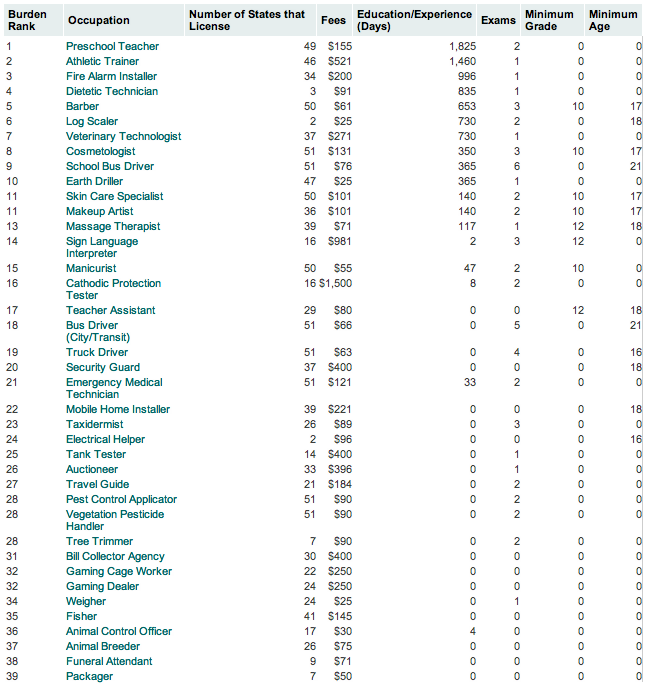
In Maine, the state licenses 39 of the 102 low- and middle-income
occupations studied. Residents seeking to enter these occupations
can anticipate, on average, paying $206 in fees, losing 226 days to
training requirements and taking one exam, making Maine’s the
30th most burdensome licensing laws.
A few occupations face significantly more burdensome entry requirements
in Maine than in other states. For example, log scalers, who grade or
estimate the value of logs, face no employment restrictions in any state
except Maine and Idaho: each requires two exams, and Maine requires
two years of experience.
Similarly, Maine is one of only three states to license dietetic technicians.
Its requirements are also the most onerous, requiring applicants to get
835 days—more than two years—of education and experience prior to licensure.
Occupations like these, where other states appear to get by with no licensing
or far lower burdens, are possible targets for reform. Other possibilities for reform include occupations that appear overly burdensome to enter compared to
others with a greater connection to health and safety.
For instance, Maine makes it more difficult to become a makeup artist,
skin care specialist or massage therapist than an emergency medical technician.
EMTs need only 33 days of training compared to more than 100 for the other occupations. (See Maine’s licensing requirements at http://licensetowork.ij.org/me.)
“License to Work” has found that on average, occupational licenses force aspiring workers to spend nine months in education or training, pass one exam and pay more
than $200 in fees. One third of the licenses take more than a year to earn.
At least one exam is required for 79 of the occupations.
“These licensing laws force people to spend a lot of time and effort earning
a license instead of earning a living,” said Dr. Dick Carpenter, director of
strategic research at the Institute for Justice and report co-author.
“They make it harder for people to find jobs and to build new businesses that create jobs.”
Data show that those practicing the 102 occupations are not only more likely
to be low-income, but also to be minority and to have less education,
likely making licensing hurdles even harder to overcome. In addition,
about half the 102 occupations offer the possibility of entrepreneurship,
suggesting these laws affect both job attainment and creation.
License to Work finds that Louisiana licenses 71 of the 102 occupations,
more than any other state, followed by Arizona (64), California (62) and
Oregon (59). Wyoming, with a mere 24, licenses the fewest, followed by
Vermont and Kentucky, each at 27. Hawaii has the most burdensome average requirements for the occupations it licenses, while Pennsylvania’s average
requirements are the lightest.
An “occupational license” is, put simply, government permission to work in a
particular field. To earn the license, an aspiring worker must clear various hurdles,
such as earning a certain amount of education or training or passing an exam.
Noted licensure expert Morris Kleiner found that in the 1950s, only one in 20 U.S. workers needed the government’s permission to pursue their chosen occupation.
Today, that figure stands at almost one in three.
Yet research to date provides little evidence that licensing protects public health
and safety or improves products and services. Instead, it increases consumer
costs and reduces opportunities for workers.
“License to Work” provides additional reasons to doubt that many licensing
regimes are needed. First, most of the 102 occupations are practiced somewhere
without government permission and apparently without widespread harm.
Only 15 are licensed in 40 states or more, and on average, the 102 occupations
are licensed in just 22 states—fewer than half. This includes a number of
occupations with no self-evident rationale for licensure, such as shampooer,
florist, home-entertainment-system installer and funeral attendant.
Second, licensure burdens often vary considerably across states, calling into
question the need for severe burdens. For instance, although 10 states require four months or more of training for manicurists, Alaska demands only about three
days and Iowa about nine days. Such disparities are prevalent throughout the
occupations studied.
Finally, the difficulty of entering an occupation often has little to do with the
health or safety risk it poses. Of the 102 occupations studied, the most
difficult to enter is interior designer, a harmless occupation licensed in
only three states and D.C. By contrast, EMTs hold lives in their hands,
yet 66 other occupations face greater average licensure burdens, including
barbers and cosmetologists, manicurists and a host of contractor designations.
States consider an average of 33 days of training and two exams enough
preparation for EMTs, but demand 10 times the training—372 days, on
average—for cosmetologists.
“The data cast serious doubt on the need for such high barriers, or any barriers,
to many occupations,” said Lisa Knepper, IJ director of strategic research and
report co-author. “Unnecessary and needlessly high licensing hurdles don’t protect
public health and safety—they protect those who already have licenses from competition, keeping newcomers out and prices high.”
Policymakers should ensure that licensing burdens are truly necessary to protect
public health and safety—and eliminate or reduce those that are not. To identify
licenses to reform or eliminate, policymakers can use the interactive version of
License to Work and start with a few simple questions:
- Is an occupation unlicensed in other states?
- Are the licensure burdens for an occupation high compared to other states?
- Are the licensure burdens for an occupation high compared to other occupations with greater safety risks?
“Finding a job or creating new jobs should not require a permission slip from the government.” Carpenter said. “As millions of Americans struggle to find productive work, one of the quickest ways legislators can help is to simply get out of the way:
reduce or remove needless licensure burdens.”
State policymakers should review current and proposed licensure schemes to determine whether they truly serve the public or instead fence out competition. As millions of Americans struggle to find productive work, one of the quickest ways
legislators could help would be to reduce or remove needless licensure burdens.
When reviewing current or proposed licensing laws, policymakers should demand proof that there is a clear, likely and well-established danger to the public from unlicensed practice. And if they do choose to license an occupation, they should carefully determine how much of the burden placed on applicants is truly needed to ensure public health and safety.
Forcing would-be workers to take unnecessary classes, engage in lengthy apprenticeships, pass irrelevant exams or clear other needless hurdles does nothing to ensure the public’s safety. It simply protects those already in the field from competition by keeping out newcomers.
Finally, policymakers should always consider whether less restrictive options—such as simply letting consumers decide for themselves—can keep the public safe while creating new opportunities for workers.
“License to Work: A National Study of Burdens from Occupational Licensing” was co-authored by Dick M. Carpenter II, Ph.D.; Lisa Knepper; Angela C. Erickson; and John K. Ross. See http://www.ij.org/licensetowork.
The Governor Mourns the Loss of one of Maine’s Finest

For Immediate Release: Tuesday, May 29, 2012
Contact: Adrienne Bennett (207) 287-2531
Governor LePage and First Lady Mourn the Death of Maine Soldier
AUGUSTA – Governor Paul R. LePage issued the following statement today regarding the death of U.S. Army Captain John “Jay” R. Brainard III, of Newport, who was killed in Afghanistan on May 28, 2012:
“It brings me great sadness to learn that Maine has lost Captain Brainard who dedicated himself to defending our State and Nation, and we are forever indebted to his display of courage and selfless sacrifice. It is with a heavy heart that I express my sincere condolences to his family and friends. This news never comes easy and is especially difficult knowing this young man made the ultimate sacrifice on Memorial Day.
As Memorial Day approached, the First Lady and I paused to honor those who have fallen in service to their country and decorated their graves with American flags. As my wife and I gazed across the Maine Veterans’ Memorial Cemetery we honored, thanked and remembered those who gave their all – not for any recognition, but for the freedoms we all value today. Our thoughts and prayers are with the family of Captain Brainard, and I join with all Mainers to forever remember him as a true son of the State of Maine.”
Captain Brainard, 26, was an active duty helicopter pilot assigned to the 12th Combat Aviation Brigade. He is a 2004 graduate of Foxcroft Academy and a 2008 graduate of the University of Maine.
Governor Vetoes LD 1781
For Immediate Release: Tuesday, May 29, 2012
Contact: Adrienne Bennett (207) 287-2531
Governor’s Veto Message Urges Union to Support Teachers’ Professional Development Not Politics
AUGUSTA – Governor Paul LePage vetoed a bill today to reaffirm the need for the Maine Education Association (MEA) to provide professional development and support to its teachers. The union represents more than 24,000 active and retired educators. Governor LePage vetoed LD 1781, An Act To Restructure the National Board Certification Program for Teachers citing he believes a more coordinated state-wide solution is required.
The LePage Administration is committed to increasing support and development training to Maine teachers, and the Governor acknowledges the importance of National Board Certification. In his veto message Governor LePage offers to eliminate teacher certification fees and increase teachers’ salaries. However, the Governor does not feel that teachers and taxpayers should be the only contributors to funding the certification process. “LD 1781 requires teachers to partially fund the program, while simultaneously paying union dues,” Governor LePage wrote in the veto message, “which are squandered on a host of activities not even remotely related to professional development.”
Governor LePage reiterated his challenge last week urging the MEA to provide teacher training to its members. In a letter to MEA President, Chris Galgay, Governor LePage encouraged the MEA to partner with the State to improve professional development opportunities. “Specifically, I pledge to budget state funds to match – dollar for dollar – any increase in professional development funds offered to teachers by the MEA,” wrote Governor LePage.
Last year, Governor LePage offered this same challenge to the union, which has yet to offer a response. “We must work together to move education ahead in Maine,” the Governor said Tuesday, “right now the union is not stepping up to the plate. Teachers should be concerned when education is being put on the back burner as a result of decision-making from union bosses.”
Just last week, Rob Walker, executive director of the Maine Education Association said “making sure we have a highly skilled work force is the job of the employer” not the union. Meanwhile, the MEA announced its endorsement recently of the same-sex marriage proposal on the November ballot. This announcement is an example of what the union is choosing to focus on rather than expanding and enhancing opportunities for teacher development.
The Governor has consistently said that in order to improve education, we must first ensure that every student has an effective teacher. Research shows that investments in effective teaching are a critical component of educational success among students. According to the National Board for Professional Teaching Standards, research indicates that the single most influential school-based factor affecting student achievement is teacher quality. Therefore, the most important thing that schools and policymakers can do to improve student outcomes is to ensure that every student has a highly accomplished teacher.

