Cold, Hard, and Final

isaacclimbing

The wind and snow had just begun to intensify as I slowly worked my way through the crags of rocks that bordered the final ascent to the peak. The whistle of the wind across the scrub oborestonepeakf the scraggly boughs in the tree line below seemed to swallow the sounds of scrapping snowshoes as my sons and I traversed the last few feet of snow swept, ice encrusted rock to the peak of Borestone Mountain. We waited, along with my nephew, on the top as the rest of our group appeared from the rocks below and made their way to the top, scaling the bluffs like ants picking their own varied approaches.

Almost immediately the hshawnclimbingikers began to pull layers from their packs that had been shed in the climb to cover themselves against the brisk wind and snow. Smiles and congratulations were shared all around as we munched on food and took in the stark wintry beauty around us. The mountain dressed in snow with the shades of grey and black exposed rock trimmed against the dark greens of the mountain conifers laid upon the backdrop of the icy ponds and winter mountains below was absolutely breathtaking. The satisfaction of conquering the mountain was palpable in the air as the snowshoeing warriors conversed together and surveyed their conquest. andrewonthepeak

The moments of revelry were short-lived, as those who have hiked in the wilderness for any length of time know that extended exposure to the harsh elements on a windswept mountain in a snow squall is not the better part of wisdom. We quickly changed our focus to primary reason for our hike. A sudden sense of gravity seemed to move amongst almost as if it were carried on the winds swirling around us.

Each of us removed from our pack a stone engraved with the name of a soldier that has fallen combat. There on that cold, snowy, peak we gathered in a circle to honor their sacrifice and bravery. With only the surrounding grey bleak cliffs, the ominous circling dark clouds, the cold wintry valleys below, and God above as our witness, we honored the fallen and pledged never to forget their sacrifice.

pfc-tyler-springmann

PFC Tyler M. Springmann.

I carried the memorial stone of PFC Tyler M. Springmann. He was born in Hartland, Maine, not far from where I live. He was stationed in Fort Wainwright, Alaska with the Stryker Brigade. He was fun loving, loved people, and wanted to be loved. He had weakness for a good Whopper and preferred the outdoors.

He was 19 years old when he joined the army, went to war, and gave his all for you and me. As I sat on that mountain looking at that stone, picked from the driveway of Tyler’s grandparents home where he used to skateboard, I was struck by how cold and how final it felt to me. Beside me on that snowy mount where my two teenage sons, who are just a few years younger than Tyler was when he gave everything he could give for his country.

In that ceremony ring, there was a young man of 17, who had just joined the Marines, honoring a fallen marine. Beside him, his mother and sister. His mother carried the stone of a soldier who had also joined the military at 17, and the day of this hike was the anniversary of his sacrifice. There also a granddaughter who carried a stone honoring her grandfather, a helicopter pilot in the Vietnam War, who had recently passed on.cliffssummitprojectborestone isaacrepelling

As we climbed, at points repelled, down the mountain, I reflected on the small sacrifice we had made to climb the mountain in comparison to great price of freedom. It was a difficult climb to be sure. Two of our group could not finish due to injury. Still even the cold cliffs of that icy mountain cannot compare to the cold hard finality of the price of freedom. These heroes from Maine we honored on this hike knew full well that price and willingly gave it. It is for us that bask in the warmth of that freedom they purchased to vow never to forget its high cost. I will never forget Tyler M. Springmann and I will never stop fighting for freedom.
tedrepelling2ndmemorial stonememorial ceremony

Faith – September 11, 2001 to March 23, 2015

DSC00034

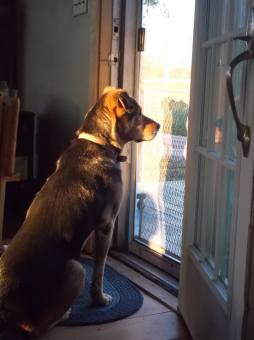
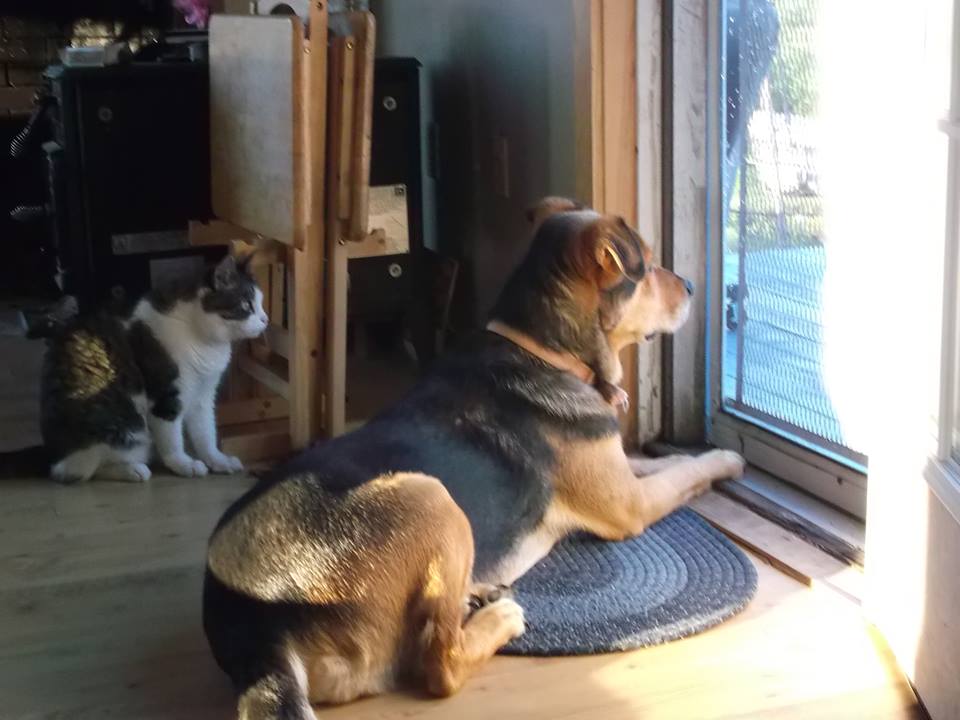
Some of you have commented on the dog that is in the picture with me on our Facebook site.  That is our family dog, Faith.  She was born on that fateful day of September 11th, 2001. She has been a devoted and beloved member of our family for 14 years now.  Always a bundle of energy,  it was a miracle to get her to sit still long enough to get a family picture with her.  Even the picture that I took for TMCV was a series of trial and errors until we got one snap shot.  That’s why we were so saddened this weekend when she suddenly took a turn for the worst and her health failed her.

She had begun this past summer to suffer seizures, which really scared us.  Then this weekend the pain of her condition really became apparent and she had to leave us.  While I’m still very emotional about it and so is my family, we are happy for the great years we had with her.faith2

When I was a little boy, my mother told me something to help me to get over the loss of a family pet. She said that if I prayed faith1to God maybe He would work a miracle and make sure that I could see that pet someday in heaven.  I’m sure that she said that to help sooth my sorrow but I’m still a little boy enough to believe that.

After all, what would heaven be without our animal friends.  So here’s to Faith and the great, beautiful, loyal friend you were and to seeing you someday in heaven.

Scary, Scary IPAB


Americans knew that when they were told that they needed to pass the healthcare law in order to see what was in the healthcare law, we were in for some deep piles of “youknowwhatssits”. Now that the Affordable Care Act has been passed, we are now learning that the healthcare monstrosity has moved into the “just wait a while and you’ll never be able to repeal it” phase. The Obama administration is hoping you’ll just “wait a while” until 2017 and here’s why.

Language within the Affordable Care Act (ACA) created a fifteen member regulatory panel called the Independent Payment Advisory Board (IPAB). The President of the United States appoints these members. This regulatory board has been given unprecedented autonomy in its legislative power in that the proposals issued from IPAB must be implemented immediately. If the President and the two chambers of Congress cannot come up with a measure that matches, not revokes or countermands, but matches the “proposal” of IPAB within a severely limited amount of time the edicts-Let’s call them what they are-from IPAB must be immediately implemented by the Secretary of Health and Human Services, according to the language in the ACA.

IPAB effectively bypasses any oversight from Congress and cannot be subjected to a veto from the President. There are no checks and balances; in fact, language in the ACA prevents IPAB from ever being repealed after 2017. The ACA goes even further to state that any ruling from the IPAB after 2017 cannot be altered, challenged, or revoked in any way.

So after you’ve wiped the spittle from off the front of your shirt from screaming and frothing, “How can this happen in the United States!!!” let’s take a step back and discuss how this happened in the United States. The simplest explanation is that the intent from the very infancy of the ACA was to bypass and circumvent the checks and balances our government. Peter Orszag, who was a chief architect for President Obama when ACA was passed, said the reason for the failed implementation of government run healthcare is that there is “too much democracy”. Orszag and the President petitioned the writers of the ACA to create IPAB and insure that it was impervious to the obstructions of government oversight. By severing the panel from a system of checks and balances and filling it with unelected members with no accountability to the public, the ACA has insured that IPAB is a law unto itself.

This secretive but all-powerful order of health regulators invokes images of Tolkien’s Ringwraiths, The Black Riders, bent upon the implementation of their dark agenda at all costs and woe to any that oppose them. In a recent article from the Cato Institute, Diane Cohen and Michael F. Cannon contend that IPAB is indeed independent but “in the worst sense of the word. It wields power independent of Congress, independent of the President, independent of the judiciary, and independent of the will of the people.”

The citizens have no recourse against the rulings of IPAB. They cannot challenge any ruling in a court of law. IPAB has the autonomous power to levy taxes and ration healthcare for US citizens, even if these citizens have private healthcare. In truth, actions from IPAB are not legislative but decrees and edicts, which cannot be questioned.

Our next post will expose how that, without repeal, IPAB has the potential to give one unelected official the unfettered power to levy taxes and regulations, appropriate funds, and to have control over the legislative process. Thankfully Maine’s Congressman Bruce Poliquin has co-sponsored a bill with Congressman David (Phil) Roe of Tennessee to repeal the Independent Payment Advisory Board. Maine’s Congresswoman Chellie Pingree must join with Congressman Poliquin to repeal this travesty to American freedom. As Cohen and Cannon have warned, IPAB is not just unconstitutional; it is “anti-constitutional.”

Bill to Repeal IPAB to be Announced

Sources in Washington D.C. have informed TMCV that Congressman Bruce Poliquin intends to announce the end of this week, possibly Thursday morning, that he is an original co-sponsor of a bill HR 1190 which repeals the Independent Payment Advisory Board (IPAB) established by the Affordable Care Act.  IPAB has been labeled by the Cato Institute as perhaps the most unconstitutional part of the ACA, and may be the most unconstitutional creation in the history of the United States.  It has also been denounced by the AAMC, the Association of American Medical Colleges.

IPAB is a regulatory board created through the Affordable Care Act, at the behest of President OBama and his Chief architect at the time Peter Orszag to bypass the checks and balances our government.  The board is composed of 15 healthcare professionals appointed by the President.  The regulatory “proposals” that are issued from IPAB are to be implemented immediately by the Secretary of Health and Human Services without approval from Congress.  If all three branches of government cannot come up with a bill that matches the precise intent of the IPAB “proposal” it becomes law, with no vote from Congress and the President  has no power of veto.

But the appalling autonomy of IPAB does not stop there!  If Congress fails to repeal IPAB before 2017, language in ACA prevents all three branches from repealing this board and/or altering any of its proposals at any time.  This gives IPAB the power to alter the Constitution through statute, or its “proposals”.  Not only does IPAB hold regulatory control over ObamaCare but it also has been granted oversight in the private healthcare market.

This is a brief overview of the egregious attack on the Constitution this facet of the ACA represents. TMCV intends to post several articles on IPAB in anticipation of the announcement of Poliquin that he has joined forces with Rep. David Roe (R-TN) to repeal IPAB.  Diane Cohen, lead counsel challenging the constitutionality of IPAB, and Michael F. Cannon, director of health policies for the Cato Institute, aptly describe IPAB as not just unconstitutional, but “anti-constitutional”.

IPAB must be repealed and abolished.  We applaud Rep. Poliquin (R-ME) and Rep. David Roe (R-TN) for their leadership on this.