Maine ranks 33rd as the most onerously licensed state
In the first national study of licensing for low- and middle-income occupations,
Maine ranks 30th in most burdensome licensing laws and 33rd as the most
onerously licensed state.
Maine’s ranking is included in “License to Work: A National Study of Burdens
from Occupational Licensing,” the first report to measure how burdensome
occupational licensing laws are for lower-income workers and aspiring
entrepreneurs. (http://www.ij.org/licensetowork)
The report reveals that more and more Americans now need the government’s permission before they can pursue the occupation
of their choice. “License to Work” shows that for lower-income Americans,
government-imposed “occupational licensing”
hurdles are not only widespread, but are often unreasonably high.
Produced by the Institute for Justice in Arlington, Virginia,
the report documents the license requirements for 102 low- and
moderate-income occupations—such as barber, massage therapist
and preschool teacher—across all 50 states and the District of Columbia.
The study found that occupational licensing is overly burdensome and frequently irrational.
In Maine, the state licenses 39 of the 102 low- and middle-income
occupations studied. Residents seeking to enter these occupations
can anticipate, on average, paying $206 in fees, losing 226 days to
training requirements and taking one exam, making Maine’s the
30th most burdensome licensing laws.
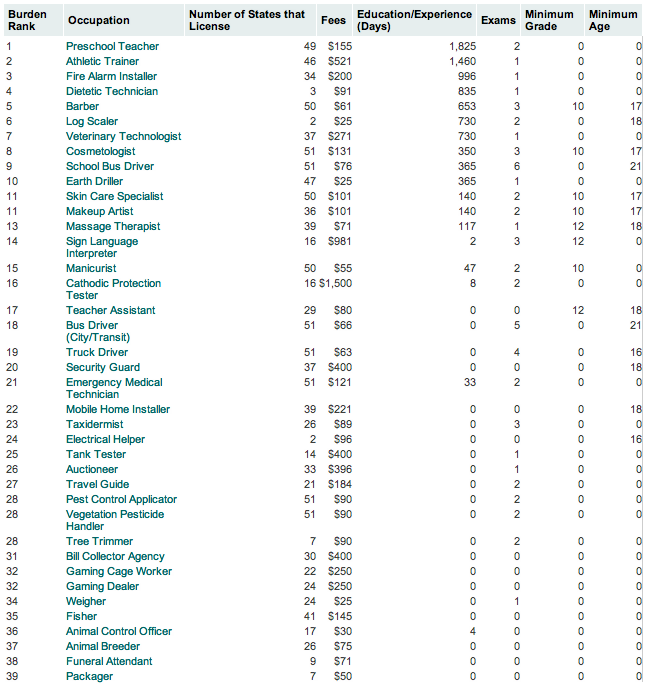
A few occupations face significantly more burdensome entry requirements
in Maine than in other states. For example, log scalers, who grade or
estimate the value of logs, face no employment restrictions in any state
except Maine and Idaho: each requires two exams, and Maine requires
two years of experience.
Similarly, Maine is one of only three states to license dietetic technicians.
Its requirements are also the most onerous, requiring applicants to get
835 days—more than two years—of education and experience prior to licensure.
Occupations like these, where other states appear to get by with no licensing
or far lower burdens, are possible targets for reform. Other possibilities for reform include occupations that appear overly burdensome to enter compared to
others with a greater connection to health and safety.
For instance, Maine makes it more difficult to become a makeup artist,
skin care specialist or massage therapist than an emergency medical technician.
EMTs need only 33 days of training compared to more than 100 for the other occupations. (See Maine’s licensing requirements at http://licensetowork.ij.org/me.)
“License to Work” has found that on average, occupational licenses force aspiring workers to spend nine months in education or training, pass one exam and pay more
than $200 in fees. One third of the licenses take more than a year to earn.
At least one exam is required for 79 of the occupations.
“These licensing laws force people to spend a lot of time and effort earning
a license instead of earning a living,” said Dr. Dick Carpenter, director of
strategic research at the Institute for Justice and report co-author.
“They make it harder for people to find jobs and to build new businesses that create jobs.”
Data show that those practicing the 102 occupations are not only more likely
to be low-income, but also to be minority and to have less education,
likely making licensing hurdles even harder to overcome. In addition,
about half the 102 occupations offer the possibility of entrepreneurship,
suggesting these laws affect both job attainment and creation.
License to Work finds that Louisiana licenses 71 of the 102 occupations,
more than any other state, followed by Arizona (64), California (62) and
Oregon (59). Wyoming, with a mere 24, licenses the fewest, followed by
Vermont and Kentucky, each at 27. Hawaii has the most burdensome average requirements for the occupations it licenses, while Pennsylvania’s average
requirements are the lightest.
An “occupational license” is, put simply, government permission to work in a
particular field. To earn the license, an aspiring worker must clear various hurdles,
such as earning a certain amount of education or training or passing an exam.
Noted licensure expert Morris Kleiner found that in the 1950s, only one in 20 U.S. workers needed the government’s permission to pursue their chosen occupation.
Today, that figure stands at almost one in three.
Yet research to date provides little evidence that licensing protects public health
and safety or improves products and services. Instead, it increases consumer
costs and reduces opportunities for workers.
“License to Work” provides additional reasons to doubt that many licensing
regimes are needed. First, most of the 102 occupations are practiced somewhere
without government permission and apparently without widespread harm.
Only 15 are licensed in 40 states or more, and on average, the 102 occupations
are licensed in just 22 states—fewer than half. This includes a number of
occupations with no self-evident rationale for licensure, such as shampooer,
florist, home-entertainment-system installer and funeral attendant.
Second, licensure burdens often vary considerably across states, calling into
question the need for severe burdens. For instance, although 10 states require four months or more of training for manicurists, Alaska demands only about three
days and Iowa about nine days. Such disparities are prevalent throughout the
occupations studied.
Finally, the difficulty of entering an occupation often has little to do with the
health or safety risk it poses. Of the 102 occupations studied, the most
difficult to enter is interior designer, a harmless occupation licensed in
only three states and D.C. By contrast, EMTs hold lives in their hands,
yet 66 other occupations face greater average licensure burdens, including
barbers and cosmetologists, manicurists and a host of contractor designations.
States consider an average of 33 days of training and two exams enough
preparation for EMTs, but demand 10 times the training—372 days, on
average—for cosmetologists.
“The data cast serious doubt on the need for such high barriers, or any barriers,
to many occupations,” said Lisa Knepper, IJ director of strategic research and
report co-author. “Unnecessary and needlessly high licensing hurdles don’t protect
public health and safety—they protect those who already have licenses from competition, keeping newcomers out and prices high.”
Policymakers should ensure that licensing burdens are truly necessary to protect
public health and safety—and eliminate or reduce those that are not. To identify
licenses to reform or eliminate, policymakers can use the interactive version of
License to Work and start with a few simple questions:
- Is an occupation unlicensed in other states?
- Are the licensure burdens for an occupation high compared to other states?
- Are the licensure burdens for an occupation high compared to other occupations with greater safety risks?
“Finding a job or creating new jobs should not require a permission slip from the government.” Carpenter said. “As millions of Americans struggle to find productive work, one of the quickest ways legislators can help is to simply get out of the way:
reduce or remove needless licensure burdens.”
State policymakers should review current and proposed licensure schemes to determine whether they truly serve the public or instead fence out competition. As millions of Americans struggle to find productive work, one of the quickest ways
legislators could help would be to reduce or remove needless licensure burdens.
When reviewing current or proposed licensing laws, policymakers should demand proof that there is a clear, likely and well-established danger to the public from unlicensed practice. And if they do choose to license an occupation, they should carefully determine how much of the burden placed on applicants is truly needed to ensure public health and safety.
Forcing would-be workers to take unnecessary classes, engage in lengthy apprenticeships, pass irrelevant exams or clear other needless hurdles does nothing to ensure the public’s safety. It simply protects those already in the field from competition by keeping out newcomers.
Finally, policymakers should always consider whether less restrictive options—such as simply letting consumers decide for themselves—can keep the public safe while creating new opportunities for workers.
“License to Work: A National Study of Burdens from Occupational Licensing” was co-authored by Dick M. Carpenter II, Ph.D.; Lisa Knepper; Angela C. Erickson; and John K. Ross. See http://www.ij.org/licensetowork.

 The Maine Conservative Voice