The Intellectualism of Stupidity Pt. 5


As Bonhoeffer watched Germany crumble, we would do well to heed his warning to the results of our craven stupor. We cling, we crave, we claw in a blind belief that we are the civilization that can transcend the laws of human descent. As we demand to avail ourselves the opportunity to repeat the disastrous mistakes of past civilizations, we should ask ourselves: Is this not the very definition of insanity?

Through the shadowy folds of Egypt’s mystery to the rage and hate of Germany, the marble columns of the Roman Empire, it’s fall into decadence, to the crumbling of the last great civilization, the United States, the last beacon of freedom, the pattern of demise is the same. It’s almost as if each civilization were made up of the same thing, humans. Creatures of habit who, despite being endowed with a capacity for reason, prefer to instinctively follow the habitual patterns of human frailty without regard of consequence.

The threads of time weave for us a pattern of warning if we would only heed it. The loss of a family structure for the nurturing and culturing of life leads to angry youths rioting and murdering in the streets. The stain and scars are in every history of every culture in its rise and fall.

For us who live in this last civilization, once called the great shining city on a hill, we are without excuse. No other peoples have had at their fingertips access to so much information, so much warning, a fabric of prophecy of sorts before us laid out on the loom of the ancients, woven a stark revelation of doom. Yet we choose to ignore them, willfully ignorant of the evidence before us left for our benefit so that we may skirt the destruction that plagues civilization.

Without life there can be no living and without living there can be no life. That is to say that the way we view life directly correlates to our quality of living. The propagation and culturing of life is the systemic lifeline to society. If a society fails to protect its foundational system of life, it will fail every time.

You need life to build a society, but the society also needs to build life. The rise and fall of a civilization is directly related to the way in which the peoples of that civilization culture life. The Marriage Construct must be protected. It is the security of the Nation.

It is through this Construct that the tenets of morality, work ethic, perseverance, law, respect, love, compassion, and love of country are passed on. For those in our Nation who feel that the government is best suited to teach those things, look at the results in the streets of today. Angry youths rioting in our streets, all nurtured and pampered on the teat of the government.

It stands to reason, if we could reason, that the foundation on which a structure is built must remain strong in order for that structure to remain strong. We have pulled away from the very thing that has kept us strong for decades, our heterosexual marriage tradition. The marriage construct has built this Nation. We are now reaping the fruits of its abandonment.

As violence fills our streets, the shouts of angry decadents spewing the reasoning for their debased acts are simply the outer rotting layers to the cancer that lies beneath. Generations of youths without a family structure to instill a code of decency, law, and order. Angrily they are tearing down the structure they have been taught to hate, while no one is doing anything to protect the foundation that holds it up.

More quickly now, we are pulled towards the ghosts of civilizations past to either learn or join them.

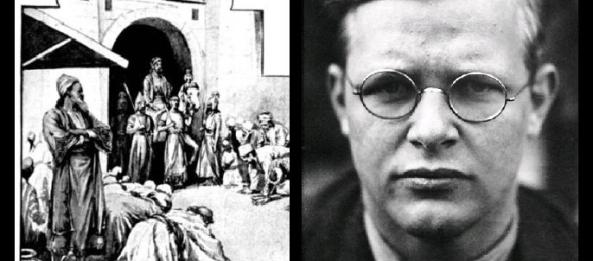
Bonhoeffer on Stupidity the entire quote

Taken from a circular letter, addressing many topics, written to three friends and co-workers in the conspiracy against Hitler, on the tenth anniversary of Hitler’s accession to the chancellorship of Germany.

‘Stupidity is a more dangerous enemy of the good than malice. One may protest against evil; it can be exposed and, if need be, prevented by use  of force. Evil always carries within itself the germ of its own subversion in that it leaves behind in human beings  at least a sense of unease. Against stupidity we are defenseless. Neither protests nor the use of force accomplish anything here; reasons fall on deaf ears; facts that contradict one’s prejudgment simply need not be believed- in such moments the stupid person even becomes critical – and when facts are irrefutable they are just pushed aside as inconsequential, as incidental. In all this the stupid person, in contrast to the malicious one, is utterly self-satisfied and, being easily irritated, becomes dangerous by going on the attack. For that reason, greater caution is called for than with a malicious one. Never again will we try to persuade the stupid person with reasons, for it is senseless and dangerous.

‘If we want to know how to get the better of stupidity, we must seek to understand its nature. This much is certain, that it is in essence not an intellectual defect but a human one. There are human beings who are of remarkably agile intellect yet stupid, and others who are intellectually quite dull yet anything but stupid. We discover this to our surprise in particular situations. The impression one gains is not so much that stupidity is a congenital defect, but that, under certain circumstances, people are made stupid or that they allow this to happen to them. We note further that people who have isolated themselves from others or who lives in solitude manifest this defect less frequently than individuals or groups of people inclined or condemned to sociability. And so it would seem that stupidity is perhaps less a psychological than a sociological problem. It is a particular form of the impact of historical circumstances on human beings, a psychological concomitant of certain external conditions. Upon closer observation, it becomes apparent that every strong upsurge of power in the public sphere, be it of a political or of a religious nature, infects a large part of humankind with stupidity. It would even seem that this is virtually a sociological-psychological law. The power of the one needs the stupidity of the other.The process at work here is not that particular human capacities, for instance, the intellect, suddenly atrophy or fail. Instead, it seems that under the overwhelming impact of rising power, humans are deprived of their inner independence, and, more or less consciously, give up establishing an autonomous position toward the emerging circumstances. The fact that the stupid person is often stubborn must not blind us to the fact that he is not independent. In conversation with him, one virtually feels that one is dealing not at all with a person, but with slogans, catchwords and the like that have taken possession of him. He is under a spell, blinded, misused, and abused in his very being. Having thus become a mindless tool, the stupdi person will also be capable of any evil and at the same time incapable of seeing that it is evil. This is where the danger of diabolical misuse lurks, for it is this that can once and for all destroy human beings.

‘Yet at this very point it becomes quite clear that only an act of liberation, not instruction, can overcome stupidity. Here we must come to terms with the fact that in must cases a genuine internal liberation becomes possible only when external liberation has preceded it. Until then we must abandon all attempts to convince the stupid person. This state of affairs explains why in such circumstances our attempts to know what ‘the people’ really thing are in vain and why, under these circumstances, this question is so irrelevant for the person who is thinking and acting responsibly. The word of the Bible that the fear of God is the beginning of wisdom declares that the internal liberation of human beings to live the responsible life before God is the only genuine way to overcome stupidity.

‘But these thoughts about stupidity also offer consolation in that they utterly forbid us to consider the majority of people to be stupid in every circumstance. It really will depend on whether those in power expect more from peoples’ stupidity. than from their inner independence and wisdom.’

-Dietrich Bonhoeffer, from ‘After Ten Years’ in Letters and Papers from Prison (Dietrich Bonhoeffer Works/English, vol. 8) Minneapolis, MN: Fortress Press, 2010

The Intellectualism of Stupidity Pt 4


As the shrouds of mystery surrounding the ruins of Egypt are slowly inched back allowing us to peer into its dim darkened halls, the shards of pottery, fragments of papyrus, and the walls of hieroglyphs remind us who seek her clues that the Egyptians were indeed human beings. They too were susceptible to the patterns of human complacency and decadence that were so starkly apparent in the civilizations they would precede. They too would build a civilization based upon the foundation of their marriage construct, yes, Egyptians were marrying long before Christians were, focused upon the generation, preservation, and cultivation of human life.

When the allure of personal pleasure and gratification caused them to abandon and compromise their foundational construct, they faced their own decline as a repercussion. The repetitive rise and fall of the Egyptian Dynasties heralded an ominous warning for civilization to come. Abandon your foundation at your own peril for if you do all that you have built upon it will crumble into the sands of time.

The patterns exist. They are etched in time. The evidence lies before us stark and cold and who could ignore it.

But we can and we do. We of all peoples of the earth and time are without excuse with so much evidence and information before us. Mountains of knowledge we eschew in order to embrace the same patterns of collapse the have plagued past civilizations. We stumble drunkenly towards our doom heedless to the calls of Egyptian leaders who decried the collapse of the family structure predicating the falls of the Egyptian Dynasties chronicled for our warning on sacred relics in hallowed tombs or the Roman Emperor who in a decree of desperation tried to protect the Heterosexual Marriage Construct by law to save a crumbling Empire, but too late as the seeds of licentious, decadent, and immoral behavior were rooted too deep in the social fabric to bring Rome back.

Through the fog of the stupor we now find ourselves, are we so debased that we cannot perceive the evidence before us that shouts through time that marriage is not about sexual preference and personal pleasure but it is about the preservation of life? It is necessary to the security of a nation and therefore must be protected as Rome learned too late. Without life there can be no living.

The modern man mocks this truth, even in anger. Our political parties scheme and work to remove those who defend these “antiquated” ideas of life from public expression. So bent on popular appeasement they forget that fact and truth are rarely popular but necessary to stability.

Dietrich Bonhoeffer understood this in his letter on stupidity. Stupidity is a more dangerous enemy of the good than malice. One may protest against evil; it can be exposed and, if need be, prevented by use of force. Evil always carries within itself the germ of its own subversion in that it leaves behind in human beings at least a sense of unease. Against stupidity we are defenseless. Neither protests nor the use of force accomplish anything here; reasons fall on deaf ears; facts that contradict one’s prejudgment simply need not be believed- in such moments the stupid person even becomes critical – and when facts are irrefutable they are just pushed aside as inconsequential, as incidental. In all this the stupid person, in contrast to the malicious one, is utterly self-satisfied and, being easily irritated, becomes dangerous by going on the attack. For that reason, greater caution is called for than with a malicious one. Never again will we try to persuade the stupid person with reasons, for it is senseless and dangerous.”

As Bonhoeffer watched Germany crumble, we would do well to heed his warning to the results of our craven stupor. We cling, we crave, we claw in a blind belief that we are the civilization that can transcend the laws of human descent. As we demand to avail ourselves to the opportunity to repeat the disastrous mistakes of past civilizations, we would do well to ask ourselves: Is not that the very definition of insanity?

The Intellectualism of Stupidity Pt. 3


Gibbon, in his time honored definitive study of the Roman Empire, offered five reasons for the fall of Rome. The first and highest impact of the five he offered was the destruction of the Heterosexual Marriage Tradition. It is incumbent upon us in a day when we are surrounded by knowledge to learn from history. Yet studies show that four out of five of modern millennials do not believe there is truth. So therein is the stupor in which we stumble drunkenly. In all our learning, will we get wisdom?

In the study of civilization past, there is perhaps none more mysterious and yet more intriguing then the Egyptian Empire. The mystery is only heightened by the fact that much of its history still lies buried in the sands of the desert. With only shards of pottery and fragments of papyrus from discovered tombs in the ever changing sands, the Silent Dynasty remains just that, silent, with only passing references found on relics from the Literary Period.

Whether you believe the Menes was the first Pharaoh or that Osiris was actually the first, who the Egyptians later deified, the fragmented references from the Literary Period acknowledge a unification of several shepherd tribes and farming communities during the Silent Period into one the most powerful empires the world has ever known, culminating in its apex at the building of the Great Pyramid. The excavations of its ruins give us only small glimpses into the shrouded genesis of Egypt, like small peeks between folds of a heavy curtain. Still, there are clues at early human behavioral patterns which are not so mysterious and not so foreign.

Ironically, the Great Pyramid initiated the beginning of the Literary Period, which would portend and document the decline and eventual sacking of the great Egyptian Empire. In all of its several dynasties, Egypt would never regain the glory which culminated with the Great Pyramid. What got it to its shining brilliance along the Nile? What precipitated its fall?

In the walls of the tombs and written on clay jars among the possessions of the dead are hints of the triggers of decline. Leaders of the day decry in disgust that the youths have no structure and run through the villages in mobs looking for people to kill. Angry youths with no family structure and discipline would be a recurring theme for the rise and fall of civilization in those that would follow Egypt.

The marriage structure, as detailed during the Literary Period, was much simpler than what we have come to expect in our day. There was no ceremony, although Egyptians loved celebrations and one would expect they would find any excuse for a party and revelry. The couple merely signed an agreement and the woman moved in.

Although by the time of the Literary Period divorce was quite prevalent, there was still a strong social stigma, a societal expectation of fidelity attached to the marriage construct. This was taught as necessary to the stability of their society. Even though the religious and traditional celebrations tended to be quite hedonistic in their rituals, the Heterosexual Marriage Tradition, on which the Egyptian Empire was built, was set aside with a code of fidelity to ensure the stable propagation and culturing of life for the future security of the empire.

As the shrouds of mystery surrounding the ruins of Egypt are slowly inched back allowing us to peer into its dim darkened halls, the shards of pottery, fragments of papyrus, and the walls of hieroglyphs remind us who seek her clues that the Egyptians were indeed human beings. They too were susceptible to the patterns of human complacency and decadence that were so starkly apparent in the civilizations they would precede. They too would build a civilization based upon the foundation of their marriage construct, yes, Egyptians were marrying long before Christians were, focused upon the generation, preservation, and cultivation of human life.

When the allure of personal pleasure and gratification caused them to abandon and compromise their foundational construct, they faced their own decline as a repercussion. The repetitive rise and fall of the Egyptian Dynasties heralded an ominous warning for civilization to come. Abandon your foundation at your own peril for if you do all that you have built upon it will crumble into the sands of time.